

Automatic Leno Bag Making Machine Manufacturer
Introduction
The demand for mesh packaging continues to create opportunities for manufacturers supplying onion, potato, garlic, and other agricultural products. Leno mesh bags are widely used for packaging fresh produce because their open mesh construction allows ventilation and makes the contents visible. However, producing consistent mesh bags requires suitable manufacturing equipment, reliable process control, and careful production planning.
For businesses entering this sector or upgrading their existing facilities, choosing the right automatic leno bag making machine is an important investment decision.
Rentech Machine Private Limited, based in Ahmedabad, Gujarat, India, provides industrial machinery solutions for the woven and flexible packaging sector. The company serves businesses looking for machinery suited to their production requirements, including applications related to bag manufacturing and conversion.
This guide explores the important factors that manufacturers should consider when selecting automatic leno bag production machinery, improving product consistency, and planning a more efficient manufacturing operation.
1. Understanding the Role of Automatic Leno Bag Manufacturing Machinery
Leno bags are mesh packaging products commonly used for agricultural commodities. Their suitability for fresh produce depends on the bag design, mesh construction, dimensions, material, and intended load.
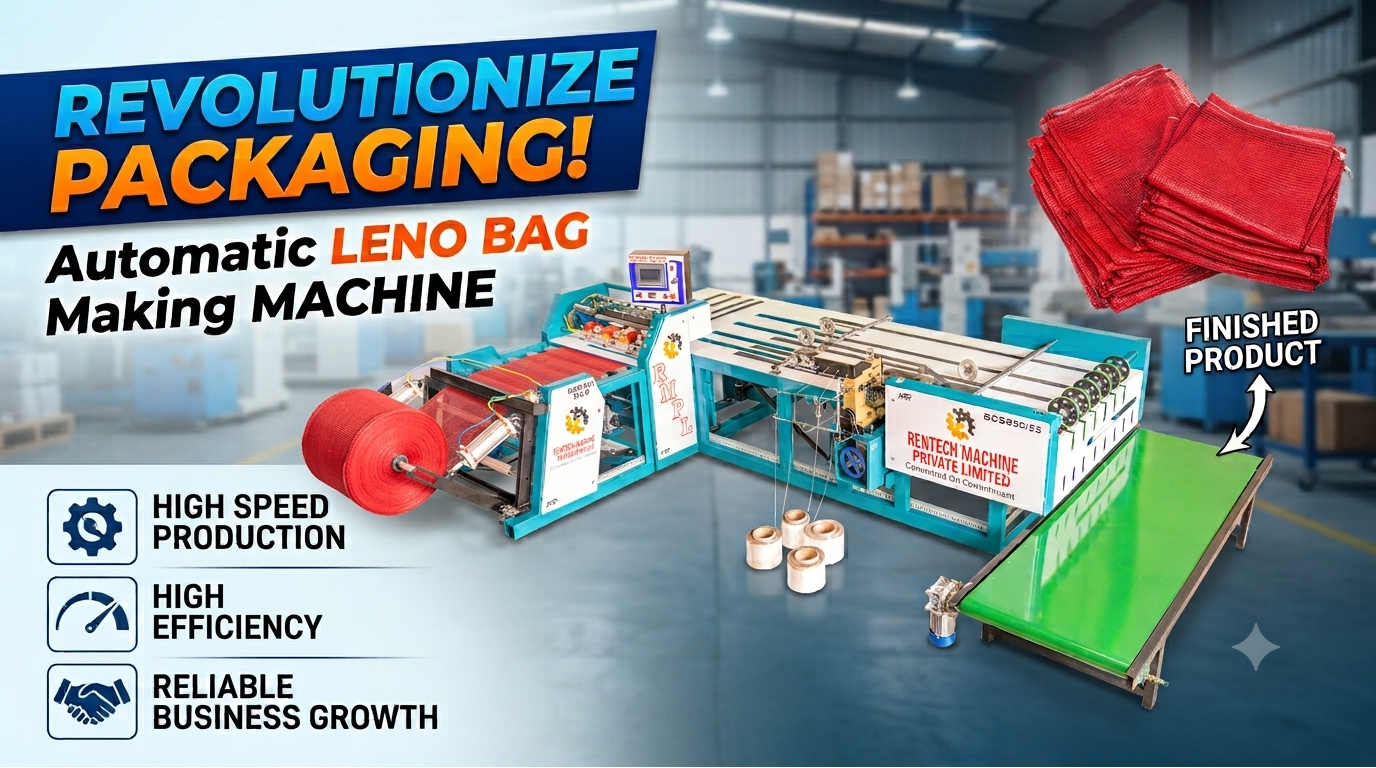
An automatic leno bag manufacturing system may integrate several production operations, depending on its design and configuration. These can include mesh production, material handling, bag formation, cutting, and other processing stages.
Manufacturers should distinguish between a complete mesh bag production line and a machine that performs only selected bag-making or conversion operations. The required equipment depends on whether the business intends to manufacture mesh material from polymer inputs or convert purchased mesh material into finished bags.
Before purchasing machinery, buyers should clarify the complete production process with the equipment supplier.
2. Why Automation Matters in Mesh Bag Production
Automation can help manufacturers standardize repetitive operations and improve coordination between different production stages. Its actual benefits depend on machine configuration, material quality, operating conditions, and operator training.
Potential advantages include:
- More consistent production settings across manufacturing batches
- Reduced dependence on certain repetitive manual operations
- Improved coordination between production stages
- Better control over bag dimensions when correctly configured
- Easier monitoring of production performance
- More structured production planning for recurring orders
Automation does not eliminate the need for quality inspections or skilled operators. Manufacturers should assess actual good-bag output, material wastage, downtime, and maintenance requirements before calculating the expected return on investment.
3. Mesh Quality: The Foundation of a Reliable Leno Bag
The quality of the finished bag depends on more than the appearance of its mesh. The bag must be suitable for the product it will carry and the conditions under which it will be handled, stored, and transported.
Important quality parameters include:
Mesh uniformity: Consistent mesh construction supports a uniform appearance and helps meet the required product specifications.
Bag dimensions: Correct width and length are important for filling, closing, stacking, and handling.
Seam strength: The bag's seams and closure areas must be appropriate for the intended load and handling conditions.
Material consistency: Suitable raw materials and stable processing conditions help maintain repeatable product quality.
Load performance: Finished bags should be evaluated against the intended filling weight and handling requirements.
Manufacturers should establish inspection criteria for every product type rather than relying only on visual checks.
4. Selecting a Machine for Different Production Requirements
Not every manufacturer requires the same level of automation. A small production unit, an established packaging supplier, and a large agricultural packaging business may have different investment priorities.
Before choosing an automatic leno bag making machine, evaluate the following:
- Required bag sizes and product range
- Target daily and monthly production
- Required mesh specifications
- Raw material and material handling requirements
- Number of operating shifts
- Available factory space and electrical infrastructure
- Operator training and maintenance support
- Spare parts availability
- Expected production wastage and downtime
- Total machinery and installation investment
Ask the manufacturer to explain the exact operations performed by the proposed machine and which additional equipment, if any, is required to produce a finished bag.
5. How to Plan Production Capacity More Accurately
Machine selection should be based on the factory's actual order requirements instead of relying exclusively on a headline speed specification.
A useful starting point is to estimate the number of saleable bags required each month.
For example, if a business needs to deliver 200,000 finished bags monthly and plans to operate for 25 days, its average requirement is:
200,000 ÷ 25 = 8,000 finished bags per working day.
The machine's required output must also account for working hours, setup time, maintenance, material changes, rejected bags, and unplanned stoppages.
Manufacturers should request a demonstration or production trial using relevant material and bag specifications wherever practical. This provides a more meaningful basis for capacity planning than an unverified rated-speed claim.
6. Raw Material and Operating Cost Considerations
The cost of manufacturing leno bags depends on multiple factors, including raw material consumption, material prices, electricity, labour, packaging, maintenance, and production losses.
A practical costing exercise should include:
- Polymer or purchased mesh material costs
- Consumables and packaging expenses
- Electricity consumption
- Labour and supervision
- Maintenance and replacement components
- Production rejects and material wastage
- Factory overheads
- Financing and machinery depreciation, where applicable
Manufacturers should calculate cost per saleable bag rather than cost per bag entering the production process. This approach gives a clearer picture of production efficiency and commercial profitability.
7. Applications of Leno Mesh Bags
Leno mesh bags are commonly used for products that benefit from airflow and visibility during storage and transportation.
Typical applications include:
- Onion packaging
- Potato packaging
- Garlic packaging
- Selected fruits and vegetables
- Agricultural produce distribution
- Wholesale vegetable markets
- Produce packing and export operations, where the packaging meets buyer requirements
The appropriate bag size, mesh construction, material, and closure arrangement depend on the intended product and required load. Exporters should also verify applicable destination-market packaging and food-contact requirements when relevant.
8. Why Work with Rentech Machine Private Limited?
Selecting machinery is not only about comparing purchase prices. Manufacturers also need clarity on equipment configuration, supported materials, production expectations, installation requirements, and service arrangements.
Rentech Machine Private Limited, located in Ahmedabad, Gujarat, India, operates in the industrial packaging machinery sector.
Businesses evaluating machinery for woven and mesh packaging applications can discuss their intended production process, required bag dimensions, target output, and automation needs with the company.
Before finalizing a purchase, prospective buyers should request the technical specification sheet, confirmed machine scope, commercial quotation, warranty terms, commissioning details, and available after-sales support for the specific model.
9. The Future of Automated Agricultural Packaging
Agricultural packaging businesses must balance product quality, operating costs, production flexibility, and timely order fulfilment. Manufacturers that monitor output, material consumption, defects, and downtime can identify opportunities for improvement.
Automation can contribute to a more organized manufacturing process when the equipment is properly selected and integrated into the production workflow.
For businesses planning to enter or expand in the leno mesh bag segment, a detailed assessment of market demand, product specifications, raw material supply, and machine capacity should come before a major machinery investment.
Conclusion
An automatic leno bag making machine can form an important part of a modern agricultural packaging operation. The right equipment depends on the production process, required bag specifications, expected demand, and available investment.
Rentech Machine Private Limited provides industrial packaging machinery solutions from Ahmedabad, Gujarat, India. Businesses considering machinery for leno bag production should clearly define their requirements and verify the capabilities of the proposed equipment before making a purchasing decision.
Planning to establish or upgrade a leno mesh bag manufacturing unit? Contact Rentech Machine Private Limited to discuss your production requirements and obtain information about suitable machinery configurations.
Frequently Asked Questions (Q&A)
Q1. What is an automatic leno bag making machine?
It is machinery designed to manufacture or process leno mesh bags through automated operations. The exact functions vary by machine model, so buyers should confirm whether the equipment produces mesh material, forms bags, cuts material, or performs several operations together.
Q2. What are leno mesh bags commonly used for?
They are commonly used for packaging onions, potatoes, garlic, and selected fruits and vegetables because their mesh structure allows ventilation and visibility.
Q3. What should I check before buying a leno bag making machine?
Check the required bag sizes, mesh specifications, actual production capacity, raw material compatibility, automation level, power requirements, installation needs, maintenance arrangements, and total investment.
Q4. Is a complete leno bag production line different from a bag conversion machine?
Yes. A complete production line may include equipment for producing mesh material as well as downstream processing. A conversion machine may process purchased mesh material into finished bags. The exact scope depends on the manufacturer's configuration.
Q5. How can I estimate the production capacity required for my business?
Calculate the monthly quantity of saleable bags required, divide it by the number of working days, and account for operating hours, downtime, changeovers, and rejects.
Q6. What determines the quality of a leno mesh bag?
Important factors include mesh uniformity, material quality, bag dimensions, seam strength, closure design, and suitability for the intended filling weight and handling conditions.
Q7. Can leno mesh bags be manufactured in different sizes?
Production flexibility depends on the machine's specifications and configuration. Confirm the minimum and maximum supported dimensions and the changeover requirements before purchasing.
Q8. How can manufacturers reduce the cost per bag?
They can monitor raw material consumption, minimize rejected products, maintain equipment regularly, improve production scheduling, and calculate costs using saleable output rather than gross production.