

How Automatic Cutting and Stitching Machines Are Transforming PP Woven Bag Manufacturing
Introduction: The Changing Landscape of Woven Bag Manufacturing
The packaging industry is continuously evolving, and PP woven bags have become an essential packaging solution across agriculture, food grains, fertilisers, cement, chemicals, animal feed, and several other industrial sectors.
As demand for woven packaging increases, manufacturers are under growing pressure to improve production efficiency, maintain consistent product quality, reduce operational dependency on manual processes, and fulfil large-volume orders within shorter delivery schedules.
Traditional bag manufacturing methods often involve multiple manual operations, including fabric measurement, cutting, handling, folding, and stitching. These activities can create production bottlenecks, increase labour requirements, and lead to variations in finished bag quality.
This is where an Automatic Cutting and Stitching Machine for PP Woven Bags becomes an important investment for modern packaging manufacturers.
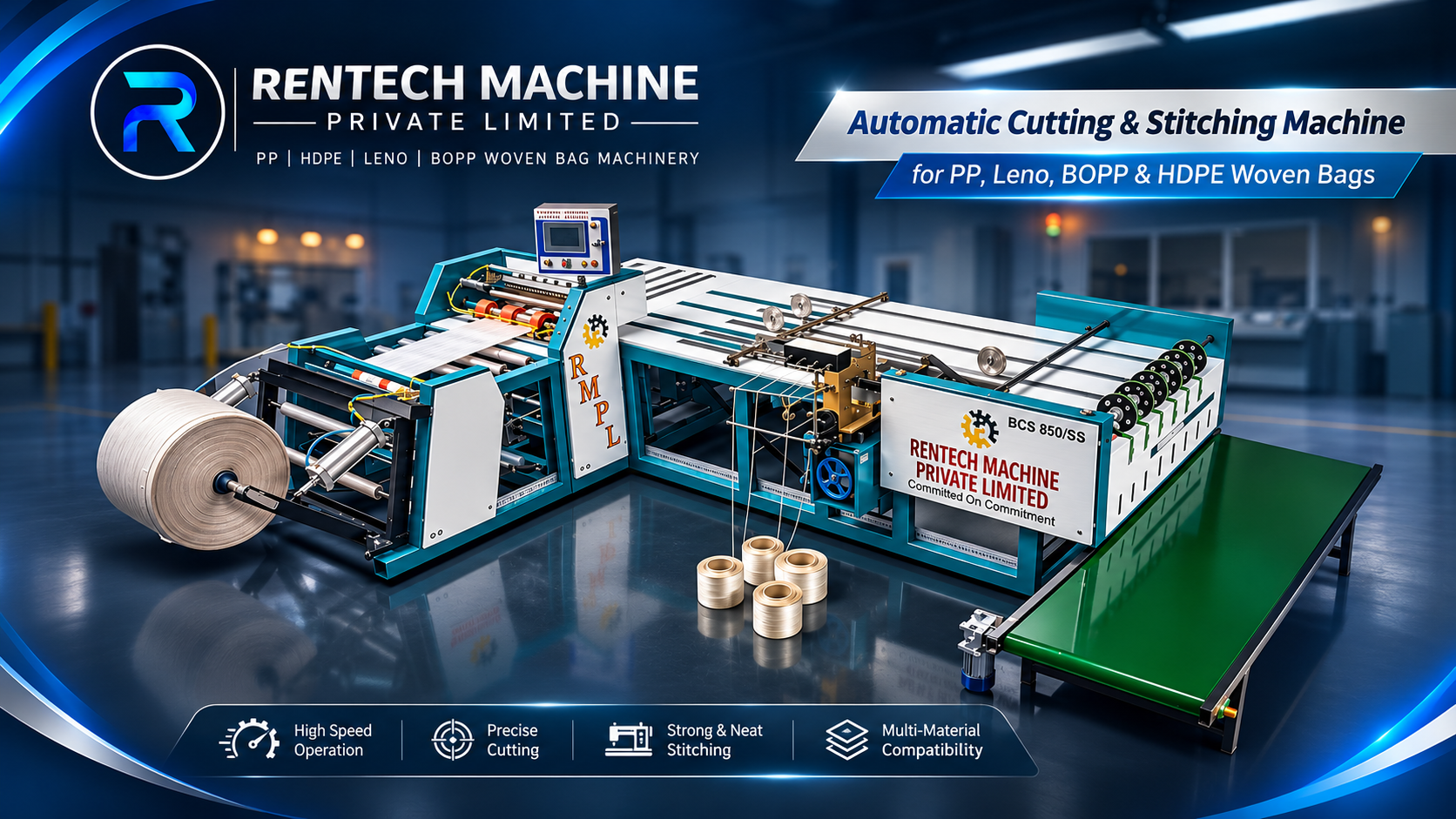
Rentech Machine Private Limited develops automatic woven bag cutting and stitching solutions designed to streamline the conversion of woven fabric into finished bags. By integrating essential production operations into an automated system, manufacturers can establish a more organised, consistent, and efficient manufacturing process.
From Woven Fabric to Finished Bags: Understanding the Conversion Process
Manufacturing a woven bag involves more than producing woven fabric. Once the fabric is ready, it must undergo several conversion operations before becoming a usable packaging product.
The conversion stage plays a significant role in determining the final appearance, dimensions, stitching quality, and overall consistency of the bag.
An automatic cutting and stitching machine simplifies this stage by combining fabric feeding, length control, cutting, and stitching operations into a coordinated production workflow.
The fabric is supplied to the machine, where it is guided through the feeding mechanism. The system controls fabric movement according to the required bag length, while the cutting arrangement separates individual bag pieces.
After cutting, the material moves towards the stitching section, where the bottom of the bag is sewn to create a finished packaging product.
This integrated approach reduces unnecessary material handling and helps manufacturers maintain a continuous production process.
Why Automation Is Becoming Important in Woven Bag Production
Automation is no longer limited to large packaging factories. Manufacturers of different production capacities are increasingly considering automated machinery to improve their manufacturing operations.
Consistent Bag Dimensions
Maintaining uniform bag dimensions is important for packaging companies supplying bulk customers. Variations in cutting length can affect filling operations, stacking, transportation, and the final presentation of the packaging.
An automatic cutting system helps maintain repeatability by controlling the fabric feeding and cutting process.
Improved Production Organisation
When cutting and stitching operations are integrated, the movement of material between different production stages becomes more organised.
This reduces unnecessary handling and helps operators manage the production process more effectively.
Reduced Manual Dependency
Manual cutting and stitching operations may require several workers depending on the production arrangement.
Automation can reduce repetitive manual activities and allow workers to concentrate on machine supervision, quality inspection, material management, and production planning.
Better Production Consistency
A coordinated cutting and stitching process helps manufacturers maintain more consistent output across production batches.
This is particularly important for businesses supplying distributors, exporters, agricultural companies, and large industrial customers.
Efficient Manufacturing Operations
By integrating multiple conversion activities, manufacturers can improve workflow management and make better use of available factory space and manpower.
Applications Across Different Woven Packaging Materials
Modern packaging manufacturers often serve multiple industries and customers with different packaging requirements. Therefore, machine versatility is an important consideration when selecting a bag conversion solution.
Automatic cutting and stitching machinery can be configured for different woven packaging applications, depending on the machine design and material compatibility.
PP Woven Bags
PP woven bags are widely used for packaging rice, wheat, sugar, fertilisers, cement, animal feed, and other industrial products.
An automatic cutting and stitching system helps convert PP woven fabric into finished bags with consistent cutting and bottom stitching.
HDPE Woven Bags
HDPE woven fabrics are used in several packaging applications where manufacturers require suitable strength, flexibility, and material performance.
Appropriate machine configurations can support HDPE woven bag conversion.
BOPP Laminated Bags
BOPP laminated woven bags are commonly used for branded packaging applications, including rice, flour, animal feed, and consumer agricultural products.
Their attractive printed appearance makes consistent cutting and finishing especially important.
PP Leno Bags
PP Leno bags are widely used for packaging onions, potatoes, garlic, vegetables, and other agricultural products.
Manufacturers serving the agricultural packaging sector require dependable conversion processes to produce bags suitable for handling, storage, and transportation.
The Importance of Cutting Accuracy in Bag Manufacturing
Cutting is one of the most important stages in woven bag conversion.
Even small variations in cutting length can create problems during subsequent stitching and packaging operations.
Incorrect cutting can result in inconsistent bag dimensions, material wastage, uneven stitching positions, and customer complaints.
An automatic cutting mechanism helps manufacturers establish a controlled cutting process.
When fabric feeding and cutting operations are properly coordinated, manufacturers can improve production repeatability and reduce inconsistencies associated with manual cutting.
For businesses handling large production orders, this consistency becomes particularly valuable.
Why Stitching Quality Matters in Finished Woven Bags
The stitching section directly influences the usability and reliability of the finished bag.
Woven bags are frequently used for carrying heavy materials, including grains, fertilisers, cement, and industrial products. Therefore, the bottom seam must be suitable for the intended application.
Poor stitching can result in seam opening, material leakage, product loss, and customer dissatisfaction.
An automatic cutting and stitching machine helps organise the stitching operation after cutting, supporting consistent bag finishing.
However, final stitching performance also depends on thread quality, needle selection, sewing adjustments, operator supervision, and the characteristics of the fabric being processed.
Manufacturers should select suitable stitching arrangements according to their intended bag applications.
How to Select the Right Automatic Bag Cutting and Stitching Machine
Selecting industrial machinery requires evaluating more than the initial purchase price.
Manufacturers should consider their present production requirements as well as their future business expansion plans.
Important considerations include:
- Material compatibility: Confirm that the machine is suitable for the woven materials being processed.
- Bag applications: Identify whether production will involve standard PP woven bags, laminated bags, BOPP bags, HDPE bags, or PP Leno bags.
- Production requirements: Evaluate the required production output according to customer demand.
- Cutting consistency: Consider the accuracy and repeatability of the cutting arrangement.
- Stitching performance: Evaluate seam quality and suitability for the intended packaging application.
- Operational requirements: Understand the manpower, maintenance, and operating conditions.
- Technical support: Consider the manufacturer's ability to provide installation guidance, spare parts, and after-sales assistance.
A machine should be selected according to the manufacturer's actual production requirements rather than purchasing equipment based only on advertised production speed.
Rentech Machine Private Limited: Supporting Modern Woven Bag Manufacturing
Rentech Machine Private Limited is engaged in the manufacturing and supply of machinery for the woven packaging industry.
With a focus on practical industrial machinery solutions, Rentech supports manufacturers involved in PP woven bag production and conversion.
The company's automatic cutting and stitching machinery is developed to help packaging manufacturers simplify their conversion operations and improve production organisation.
Rentech's machinery solutions cater to different woven packaging applications, including PP woven, HDPE, BOPP laminated, and PP Leno bags, subject to the appropriate machine configuration.
The objective is to provide manufacturers with machinery that supports efficient operations, consistent production, and long-term manufacturing development.
For businesses planning to establish a new woven bag conversion facility or upgrade existing production operations, selecting suitable machinery and dependable technical support is an important part of the investment decision.
Frequently Asked Questions (FAQs)
What is an automatic cutting and stitching machine for woven bags?
An automatic cutting and stitching machine is industrial equipment used to convert woven fabric rolls into finished bags. It combines fabric feeding, controlled cutting, and stitching operations to simplify the woven bag conversion process.
Can an automatic cutting and stitching machine manufacture PP woven bags?
Yes. Suitable machine configurations can process PP woven fabric and convert it into finished bags for applications such as rice, fertiliser, sugar, cement, grains, and animal feed packaging.
Can the machine process BOPP laminated woven fabric?
Yes, compatible configurations can process BOPP laminated woven fabric. Manufacturers should confirm material specifications and machine suitability before purchasing.
Is the machine suitable for PP Leno bags?
Yes. Suitable configurations can be used for PP Leno bag conversion, which is commonly required for onion, potato, garlic, and vegetable packaging.
Can the same machine process HDPE woven bags?
Depending on its configuration and material compatibility, the machine can be used for HDPE woven bag conversion.
What is the advantage of combining cutting and stitching operations?
Combining these operations helps streamline the production workflow, reduces intermediate material handling, improves production organisation, and supports consistent bag finishing.
Does an automatic machine reduce labour requirements?
Automation can reduce the need for repetitive manual cutting and handling activities. Actual manpower requirements depend on the machine configuration, production arrangement, and factory operations.
How does automatic cutting improve bag quality?
Controlled fabric feeding and cutting help maintain more consistent bag dimensions, reducing variations that may otherwise affect stitching and final bag appearance.
Which industries use bags manufactured using these machines?
The finished bags are used across agriculture, food grains, fertilisers, cement, chemicals, animal feed, seeds, and other industrial packaging sectors.
What should manufacturers consider before purchasing a woven bag conversion machine?
Manufacturers should evaluate material compatibility, bag applications, production requirements, cutting accuracy, stitching quality, machine reliability, maintenance requirements, and after-sales technical support.
Why choose Rentech Machine Private Limited?
Rentech Machine Private Limited offers machinery solutions for woven bag conversion applications, with a focus on practical manufacturing requirements, material compatibility, production efficiency, and technical support.
Building a More Efficient Woven Bag Manufacturing Facility
The future of woven packaging manufacturing will increasingly depend on production efficiency, consistent product quality, and the ability to respond to changing customer requirements.
An automatic cutting and stitching machine provides manufacturers with an opportunity to streamline their woven bag conversion operations by bringing important production activities together in one coordinated system.
Whether manufacturing PP woven bags for agricultural applications, laminated BOPP bags for branded packaging, or Leno bags for vegetable markets, choosing an appropriate conversion machine can contribute to a more organised and productive manufacturing facility.
Rentech Machine Private Limited aims to support this manufacturing journey with automatic cutting and stitching machinery designed for the evolving requirements of the woven packaging industry.
Contact Rentech Machine Private Limited to discuss your woven bag manufacturing requirements and explore suitable machine solutions for your business.