

Automatic Cutting Machine for PP Leno, BOPP and HDPE Bags – Rentech Machine Private Limited
Introduction: Advanced Cutting Solutions for Woven Bag Manufacturing
In the woven packaging industry, accurate cutting, consistent bag dimensions, and efficient production processes are essential for maintaining product quality. With increasing demand for PP woven sacks, PP leno bags, BOPP laminated bags, and HDPE woven packaging, manufacturers need reliable machinery that supports consistent output and reduces repetitive manual operations.
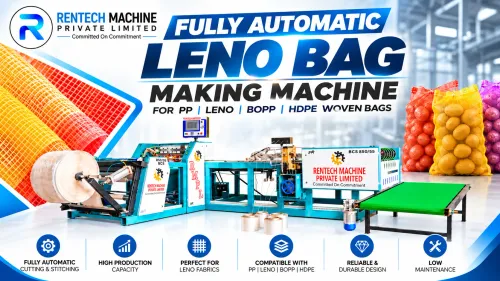
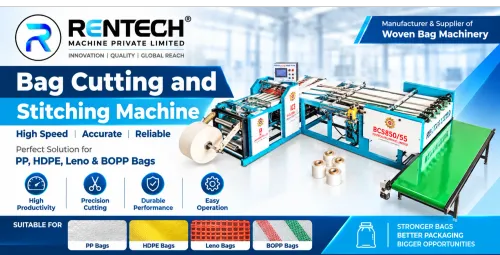
Rentech Machine Private Limited, based in Ahmedabad, Gujarat, India, offers machinery solutions for woven sack conversion, including automatic cutting and stitching machines designed for suitable PP, HDPE, leno, and BOPP woven materials.
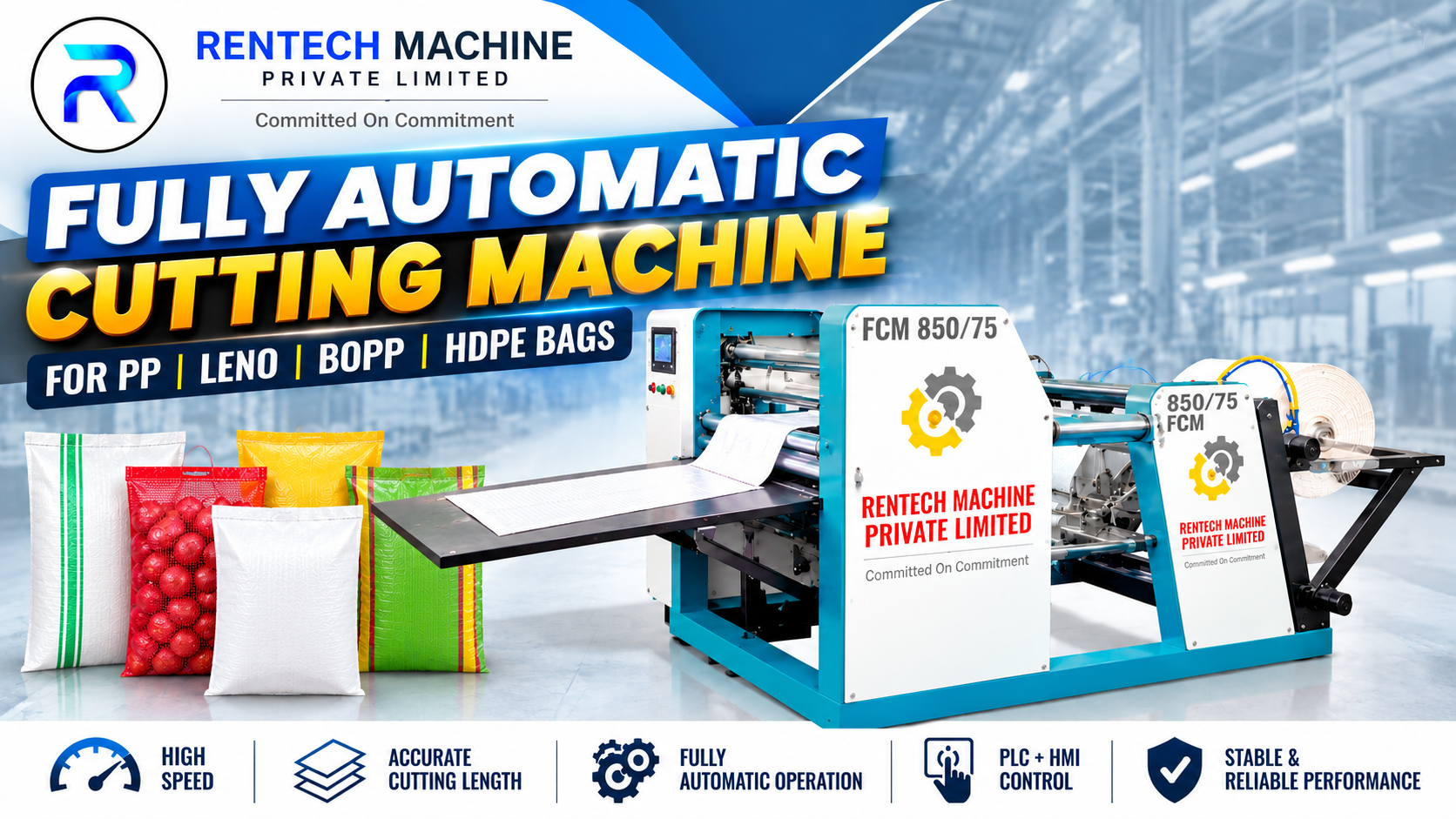
An automatic cutting machine helps convert woven fabric into the required bag lengths before subsequent operations such as stitching, hemming, printing, and other finishing processes. Depending on the machine configuration, automation can improve cutting consistency, simplify operator tasks, and support an organized production workflow.
For manufacturers planning to improve their woven bag production facilities, choosing the right automatic cutting machine is an important step toward achieving consistent bag quality and efficient factory operations.
What Is an Automatic Cutting Machine for Woven Bags?
An automatic woven bag cutting machine is industrial equipment used to cut woven fabric or tubular material into predetermined lengths according to the required bag size.
Instead of relying entirely on manual measurement and cutting, the machine uses a controlled feeding and cutting system to produce repeatable lengths. Depending on the model, its functions may include automatic feeding, length setting, cutting control, and integration with a stitching or bag conversion system.
Automatic cutting machines can support several woven packaging applications, including:
- PP woven bags used for agricultural products, grains, seeds, fertilizers, and industrial materials.
- PP leno bags used for onions, potatoes, garlic, and other agricultural produce.
- BOPP laminated woven bags used for branded packaging and retail applications.
- HDPE woven bags used for agricultural, industrial, and general-purpose packaging.
- Laminated and unlaminated woven fabrics, depending on the machine configuration.
The appropriate cutting arrangement depends on the fabric construction, bag dimensions, production requirements, and desired finishing process.
How Does an Automatic Woven Bag Cutting Machine Work?
A typical automatic cutting process involves several coordinated operations.
1. Fabric Loading and Feeding
The woven fabric roll is mounted on the machine's unwinding or feeding arrangement. The fabric moves through the feeding path while the machine maintains suitable alignment.
2. Bag Length Setting
The required cutting length is configured according to the bag specifications. Correct settings help maintain consistent dimensions and provide the appropriate allowance for downstream stitching.
3. Fabric Positioning
The feeding mechanism advances the fabric to the selected length. Depending on the machine design, positioning may be controlled through rollers, measurement systems, sensors, or other mechanisms.
4. Automatic Cutting
Once the configured length is reached, the cutting mechanism separates the fabric. The cutting method should be suitable for the material and required edge finish.
5. Collection and Transfer
The cut pieces are collected manually or transferred through the machine's discharge arrangement. Integrated systems may move the pieces toward the next conversion operation.
6. Stitching and Finishing
Where cutting and stitching equipment are integrated, the cut material proceeds to the stitching section for seam formation. Additional finishing operations depend on the bag design and customer requirements.
This process helps manufacturers standardize repetitive production activities and maintain a more organized manufacturing workflow.
Materials Suitable for Automatic Bag Cutting
PP Woven Bags
Polypropylene woven fabric is widely used for packaging grains, pulses, cement, fertilizers, animal feed, and other bulk products. An appropriate cutting machine helps manufacturers prepare repeatable bag lengths for subsequent conversion.
PP Leno Bags
PP leno bags feature an open-mesh structure that supports ventilation. They are commonly used for packaging onions, potatoes, garlic, and selected agricultural products.
When processing leno fabric, manufacturers should evaluate mesh stability, cutting quality, and compatibility with the intended bag construction.
BOPP Laminated Woven Bags
BOPP woven bags generally combine woven polypropylene fabric with a laminated, printed, or printable film. They are popular for packaging applications where branding, graphics, and an attractive finish are important.
The cutting system must be suitable for the laminated structure to help maintain clean cuts while minimizing unwanted film damage or delamination.
HDPE Woven Bags
HDPE woven fabric is used in various agricultural, industrial, and packaging applications. Machine suitability depends on the fabric construction, thickness, dimensions, and required cutting quality.
Material compatibility should always be confirmed for the selected machine, particularly when processing laminated, coated, or open-mesh fabrics.
Key Advantages of an Automatic Cutting Machine
1. Consistent Bag Dimensions
Repeatable cutting helps reduce variation between fabric pieces. Consistent dimensions are important when bags must meet customer specifications or fit a downstream stitching process.
2. Reduced Manual Work
Automation reduces repetitive measuring and cutting tasks. Operators can focus on material handling, production supervision, quality checks, and other manufacturing activities.
3. Improved Production Workflow
A properly configured cutting machine can reduce unnecessary handling between fabric preparation and stitching. Integration with a suitable conversion line can further streamline material movement.
4. Better Material Utilization
Accurate feeding and cutting can help reduce avoidable length errors and rejected pieces. Actual savings depend on fabric quality, operating conditions, machine settings, and production planning.
5. Consistent Stitching Preparation
Uniformly cut pieces make it easier to maintain consistent stitching allowances and finished bag dimensions, provided the cutting and stitching operations are correctly coordinated.
6. Flexible Production
A suitable machine configuration can accommodate different bag lengths within its operating range. This flexibility helps manufacturers serve customers with varying packaging requirements.
7. Improved Production Control
Automated operation makes it easier to monitor production output, operating time, material usage, and rejected pieces when suitable monitoring procedures are in place.
Applications of Automatic Cutting Machines in Different Industries
Automatic woven bag cutting machines support production across several packaging sectors.
- Agriculture: PP leno bags and woven sacks for onions, potatoes, garlic, grains, and seeds.
- Fertilizer manufacturing: Woven packaging prepared for fertilizer filling and distribution.
- Food and animal feed: Woven sacks for suitable grains, feed, and other bulk products.
- Building materials: Woven packaging used for selected construction and industrial materials.
- Industrial packaging: PP and HDPE woven bags for compatible dry goods and bulk materials.
- Branded packaging: BOPP laminated woven bags requiring consistent dimensions for subsequent printing, filling, and finishing.
The final application depends on the bag construction, intended contents, filling method, and customer specifications.
How to Choose the Right Automatic Bag Cutting Machine
Before investing in an automatic cutting machine, manufacturers should evaluate their actual production requirements.
Understand your bag sizes: Identify the required bag lengths, fabric widths, and stitching allowances before selecting a machine.
Identify the fabric materials: Confirm whether the machine will process PP woven, PP leno, HDPE woven, BOPP laminated, or multiple compatible materials.
Determine your production requirements: Estimate daily demand, working shifts, operating time, and required output. Ask the manufacturer to clarify the expected production rate under actual operating conditions.
Check the cutting quality: Evaluate the edge finish and material handling, particularly for laminated or open-mesh fabrics.
Consider downstream operations: If stitching is the next production step, assess whether the cutting machine can be integrated with suitable stitching or conversion equipment.
Evaluate operating costs: Consider the machine investment, installation, electricity consumption, labour requirements, spare parts, and routine maintenance.
Request a material trial: Whenever possible, provide actual fabric samples and request a demonstration using your required bag sizes and production conditions.
These considerations help manufacturers select equipment that fits their production needs rather than choosing a machine based solely on general performance claims.
Why Choose Rentech Machine Private Limited?
Rentech Machine Private Limited is an Ahmedabad, Gujarat-based machinery manufacturer serving woven sack production and conversion requirements.
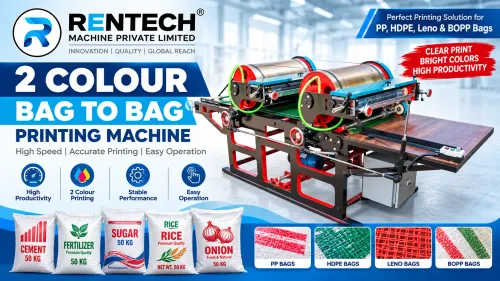
The company offers machinery solutions for applications involving woven bag cutting, stitching, printing, and conversion. Manufacturers can discuss their fabric type, bag dimensions, production goals, and preferred automation level to identify a suitable machine configuration.
When evaluating an automatic cutting machine from Rentech, customers can discuss:
- Compatibility with PP woven, PP leno, HDPE woven, and suitable BOPP laminated materials.
- Required bag dimensions and cutting requirements.
- Expected production capacity under the intended operating conditions.
- Integration with stitching equipment or a woven bag conversion line.
- Installation, operator training, maintenance, and spare-parts requirements.
- Technical support and machine configuration options.
The most suitable machine should be selected according to verified specifications, actual fabric trials, and the manufacturer's production requirements.
Frequently Asked Questions (FAQs)
1. What is an automatic cutting machine for PP woven bags?
It is industrial equipment that cuts PP woven fabric into specified lengths for bag conversion. Depending on the configuration, it may provide automatic feeding, length control, cutting, and transfer to subsequent operations.
2. Can one machine cut PP, HDPE, PP leno, and BOPP laminated bags?
A suitably configured machine may process multiple compatible materials. Fabric construction, lamination, thickness, cutting method, and edge-quality requirements should be checked before confirming compatibility.
3. Is an automatic cutting machine suitable for onion and potato leno bags?
Yes. A machine configured for the relevant PP leno fabric can cut material for onion and potato bags. Mesh stability, cutting quality, bag dimensions, and stitching requirements should be verified.
4. What determines the cutting accuracy of a woven bag cutting machine?
Cutting accuracy depends on the feeding and measurement system, fabric tension, material alignment, cutting mechanism, machine condition, and correct operating settings.
5. Can an automatic cutting machine be connected to a stitching machine?
Depending on the model, the cutting machine may operate independently or integrate with compatible stitching and conversion equipment. Integration should be confirmed during technical discussions.
6. What is the production capacity of an automatic bag cutting machine?
Production capacity depends on the machine model, cutting length, feeding speed, fabric characteristics, operating cycle, and material-handling arrangement. Manufacturers should request model-specific output figures and clarify the expected practical production rate.
7. Is hot cutting or cold cutting better for woven bags?
Neither method is universally better. The choice depends on the material, edge-finish requirements, lamination, and whether heat-related effects are acceptable. Material trials are recommended for sensitive fabrics.
8. Can an automatic cutting machine process BOPP laminated woven fabric?
It can be considered if the selected machine and cutting method are suitable for the laminated material. A sample trial should confirm cut quality and laminate integrity.
9. What information is required to request a quotation?
Provide the fabric type, required bag dimensions, production target, cutting requirements, automation preferences, and whether stitching or other downstream equipment is needed.
10. How can manufacturers reduce material waste during cutting?
Maintain correct length settings, suitable fabric tension, proper material alignment, and regular cutting-component maintenance. Monitor cut dimensions and record rejected pieces to identify production deviations.
Improve Your Woven Bag Manufacturing Process
An automatic cutting machine is an important component of an efficient woven bag manufacturing process. Consistent cutting lengths, suitable fabric handling, dependable operation, and compatibility with downstream stitching can contribute to better production control.
For PP woven sacks, PP leno bags, HDPE woven bags, and BOPP laminated packaging, the right machine should match the actual material, bag dimensions, output requirements, and finishing process.
Rentech Machine Private Limited supports manufacturers seeking machinery solutions for woven bag cutting, stitching, printing, and conversion applications. Contact the Rentech team to discuss your production requirements and identify a suitable machine for your factory.
Request a quotation: Visit https://rentechmachine.com/ to discuss your bag cutting and conversion requirements with Rentech Machine Private Limited.