

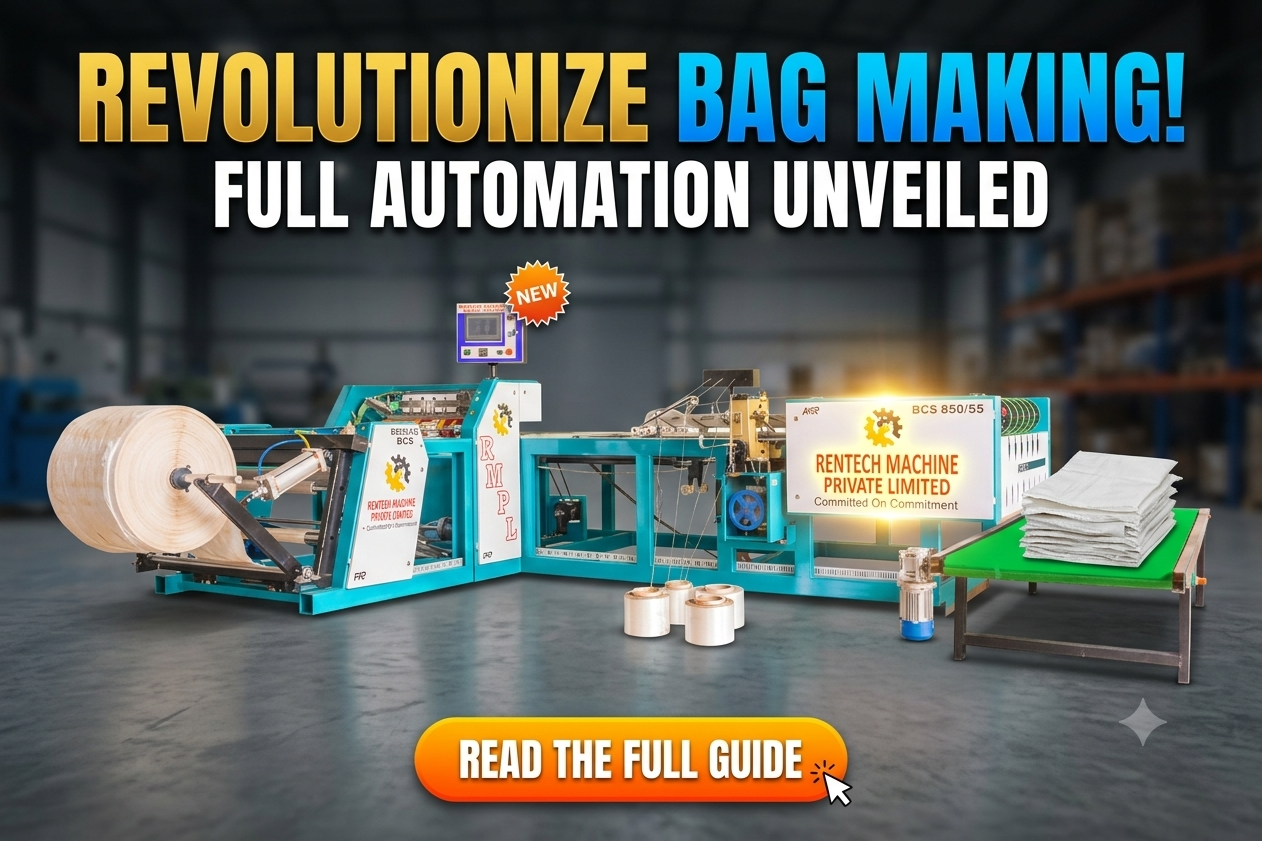
How Bag Cutting and Stitching Machines Improve Quality in PP Woven Sack Manufacturing
Introduction
In the packaging industry, the quality of a woven sack depends on more than the raw material used in production. Accurate cutting, consistent dimensions, strong stitching, and proper finishing all contribute to the final quality of the bag. For manufacturers working with PP woven sacks, HDPE woven bags, leno bags, and other woven packaging materials, selecting suitable conversion machinery is an important production decision.
Rentech Machine Private Limited, based in Ahmedabad, Gujarat, India, provides machinery solutions for woven bag cutting and stitching applications. Its bag cutting and stitching machines are designed to support packaging manufacturers in converting woven fabric into bags according to their production requirements.
This article explains how bag cutting and stitching machinery supports manufacturing quality, what buyers should evaluate before purchasing equipment, and how manufacturers can improve their overall production workflow.
1. Why Cutting Accuracy Matters in Woven Bag Manufacturing
Cutting is one of the first critical operations in the woven sack conversion process. If the fabric is not cut to the required length, the finished bags may vary in size. This can create difficulties during stitching, stacking, packing, and subsequent printing or packaging operations.
A suitable PP woven bag cutting machine helps manufacturers maintain consistent bag dimensions when the fabric is properly aligned and the machine is correctly adjusted.
Important factors include:
- Required bag length and fabric width
- Fabric alignment during feeding
- Cutting blade condition and adjustment
- Consistency of the feeding mechanism
- Operator setup and routine maintenance
For manufacturers producing bags in multiple sizes, machine flexibility and ease of adjustment can also influence day-to-day productivity.
2. The Role of Stitching in Finished Bag Quality
Stitching helps maintain the structural integrity of woven sacks during filling, handling, transportation, and storage. Poor stitching may lead to loose seams, uneven edges, thread breakage, or premature bag failure.
A suitable bag stitching machine should be selected according to the fabric construction, bag application, required seam type, and production volume.
Manufacturers should pay attention to:
- Stitch consistency across the bag width
- Thread tension and thread quality
- Needle condition and replacement intervals
- Fabric movement through the stitching section
- Operator skill and machine adjustment
Correct machine settings and preventive maintenance are essential for achieving repeatable stitching quality.
3. Manual and Automatic Bag Cutting and Stitching Solutions
Different factories have different production targets. A small packaging unit may prioritize investment cost and operational simplicity, while a high-volume manufacturing plant may require a more automated conversion process.
Manual or semi-automatic machinery may suit businesses with variable order sizes, lower production requirements, or greater dependence on operator-controlled operations.
Automatic bag cutting and stitching machinery may be appropriate for manufacturers seeking more consistent material handling, reduced repetitive manual work, and improved production flow.
Before selecting a machine, buyers should compare the actual operating speed, changeover time, operator requirements, supported fabric types, maintenance needs, and total installation cost. Automation alone does not guarantee higher output; the entire production process must be properly configured.
4. Which Materials Can Be Processed?
Bag cutting and stitching machinery may be configured for different woven and related packaging materials, depending on the machine model and its specifications.
Common applications include:
- PP woven sacks used for grains, fertilizers, and industrial packaging
- HDPE woven bags for suitable packaging applications
- Leno mesh bags used for agricultural products
- Laminated woven sacks, where supported by the machine configuration
- Other compatible woven fabrics specified by the manufacturer
Material thickness, weave construction, lamination, bag dimensions, and finishing requirements should be confirmed before placing an order. Buyers should provide fabric samples and their intended bag specifications whenever possible.
5. How to Improve Production Efficiency Without Compromising Quality
Increasing machine speed is not the only way to improve manufacturing performance. Unplanned stoppages, incorrect cutting lengths, thread breakage, and frequent adjustments can reduce effective output even when a machine has a high rated speed.
Manufacturers can improve their production workflow through several practical measures.
Standardize bag dimensions: Establish clear cutting-length and width requirements for each product.
Inspect fabric before processing: Check roll condition, alignment, and material consistency before starting production.
Maintain cutting and stitching components: Inspect blades, needles, thread paths, and other wear components according to the machine manufacturer's maintenance schedule.
Monitor rejected bags: Record common defects and identify whether they originate from feeding, cutting, stitching, or material quality.
Train machine operators: Ensure that operators understand machine adjustments, safe operating procedures, and basic troubleshooting.
Measure actual output: Track good bags produced per hour rather than relying only on the machine's rated speed.
These practices help manufacturers identify production bottlenecks and make better use of their machinery.
6. Choosing the Right Bag Cutting and Stitching Machine
Selecting a machine requires an assessment of present production requirements and expected future demand. A machine that suits one factory may not be appropriate for another because bag sizes, fabric types, order volumes, and labor arrangements differ.
Before purchasing a PP woven bag cutting and stitching machine, consider the following checklist:
- Maximum and minimum cutting length
- Maximum fabric width
- Required production speed and actual output
- Supported material types and fabric thickness
- Manual, semi-automatic, or automatic operation
- Stitching configuration and seam requirements
- Power supply and installation requirements
- Spare parts, maintenance, and technical support
- Warranty terms and commissioning assistance
- Total investment cost and expected production utilization
Request a technical quotation based on your actual requirements rather than comparing machines only by price.
7. Why Consider Rentech Machine Private Limited?
Rentech Machine Private Limited offers machinery solutions for businesses involved in woven sack manufacturing and conversion. Based in Ahmedabad, Gujarat, India, the company serves the industrial packaging machinery segment.
When evaluating Rentech machinery, prospective buyers can discuss their required bag dimensions, fabric type, production target, and level of automation to identify an appropriate configuration.
The selection process should focus on practical production needs, machine specifications, operational reliability, and after-sales support. Buyers are encouraged to confirm the exact features, rated output, compatibility, and commercial terms for the specific model under consideration.
Conclusion
A well-planned cutting and stitching process helps PP woven bag manufacturers achieve consistent dimensions, dependable seams, and a more organized production workflow. The right machine depends on the type of fabric, bag size, target output, automation requirements, and available investment.
Rentech Machine Private Limited supports the woven packaging machinery sector with bag cutting and stitching solutions for relevant industrial applications. Manufacturers planning to upgrade existing equipment or establish a new conversion unit should evaluate their production requirements carefully before choosing a machine.
Looking for a suitable PP woven bag cutting and stitching machine? Contact Rentech Machine Private Limited with your fabric details, bag dimensions, and expected production capacity to discuss a suitable machine configuration.
Frequently Asked Questions (Q&A)
Q1. What is a PP woven bag cutting and stitching machine?
It is industrial machinery used to cut PP woven fabric into the required bag lengths and stitch the edges or openings according to the intended bag design.
Q2. Which industries use bag cutting and stitching machines?
These machines are used by woven sack manufacturers and packaging businesses supplying agricultural, fertilizer, food-grain, chemical, and other industrial packaging markets, subject to the bag's intended application.
Q3. Can one machine process both PP and HDPE woven fabric?
Some machine configurations can process both materials. Compatibility depends on the fabric construction, thickness, machine design, and stitching setup. Confirm the supported materials with the manufacturer.
Q4. What is the difference between manual and automatic bag cutting and stitching machines?
Manual machines require more operator involvement in certain production operations. Automatic configurations can automate selected feeding, cutting, conveying, or stitching functions. The exact level of automation varies by model.
Q5. How can manufacturers reduce cutting errors?
Use correct machine settings, maintain proper fabric alignment, inspect the cutting blade, verify the required length, and perform regular checks on finished bags.
Q6. What causes stitching defects in woven sacks?
Common causes include incorrect thread tension, worn needles, unsuitable thread, improper machine settings, fabric feeding problems, and inadequate maintenance.
Q7. How do I calculate the production capacity required for my factory?
Estimate your daily demand, available operating hours, planned shifts, and expected downtime. Compare these requirements with the machine's verified operating speed and expected good-bag output.
Q8. Is an automatic machine always better than a manual machine?
No. An automatic machine may benefit high-volume operations, but the investment should be justified by production demand, labor requirements, consistency needs, and expected utilization.