


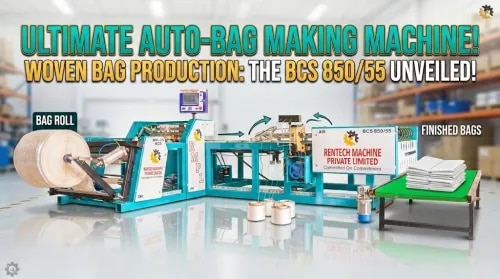
PP Woven Sack Production with Advanced Bag Cutting and Stitching Technology Introduction In the modern packaging industry, manufacturers need reliable machinery that can convert woven fabric into finished bags with consistent dimensions, strong stitching, and professional finishing. A Bag Cutting and Stitching Machine plays a vital role in this process by helping manufacturers transform PP woven fabric rolls into ready-to-use packaging bags. Rentech Machine Private Limited provides industrial machinery solutions for PP woven sack manufacturers, packaging companies, and businesses involved in woven bag conversion. Our bag cutting and stitching solutions are designed to support production workflows involving fabric feeding, length measurement, cutting, and stitching, depending on the machine configuration. Whether a manufacturing unit produces bags for agricultural commodities, fertilizers, grains, animal feed, or industrial materials, selecting suitable cutting and stitching equipment can help improve process consistency and reduce dependence on manual operations. Understanding the Role of Cutting and Stitching Technology Bag manufacturing involves more than simply cutting fabric into pieces. Each bag must meet the required dimensions and have a properly finished edge or stitched mouth, according to its intended application. An industrial cutting and stitching system helps coordinate important production stages: Fabric feeding: Woven fabric is supplied to the cutting section. Length measurement: The required bag length is set according to production requirements. Fabric cutting: The material is cut to the selected dimensions. Edge preparation: The cut material is positioned for the stitching operation. Stitching: The required seam is formed using the configured stitching system. Quality inspection: Finished bags are checked for dimensions, seam quality, and visible defects. The exact sequence and level of automation depend on the selected model and machine configuration. Why Production Consistency Matters in Woven Bag Manufacturing For packaging manufacturers, consistent bag dimensions are important for filling operations, stacking, transportation, and customer requirements. Variations in cutting length or stitching quality can lead to material waste, rework, and inconsistent finished products. A properly configured bag cutting and stitching machine can help manufacturers establish a more repeatable production process. Appropriate machine settings, routine maintenance, correct fabric handling, and operator training are all important for achieving consistent results. Rentech Machine Private Limited focuses on machinery solutions that help woven sack manufacturers organize their conversion operations and support their production objectives. Applications Across Different Industries PP woven bags are used in several sectors because woven polypropylene fabric offers a practical packaging solution for many dry products. Common applications include: 1. Agricultural Packaging Woven bags are widely used for packaging grains, seeds, pulses, onions, potatoes, and other agricultural products, depending on the bag specification. 2. Fertilizer Packaging Manufacturers use woven sacks for fertilizer packaging where suitable fabric construction, dimensions, and stitching are required. 3. Animal Feed Packaging Feed manufacturers require bags with consistent dimensions and dependable seam construction for handling and transportation. 4. Industrial Material Packaging PP woven sacks are also used for packaging various industrial materials and bulk commodities. 5. General Packaging Applications Depending on the fabric structure and bag design, woven sacks can serve multiple commercial packaging requirements. Selecting the Right Machine for Your Production Unit Before investing in a bag cutting and stitching machine, manufacturers should evaluate their actual production requirements instead of selecting equipment based on speed alone. Important factors include: Required bag width and cutting length Type and thickness of woven fabric Required production output per minute or per hour Manual, semi-automatic, or fully automatic operation Stitching pattern and seam requirements Available factory space and electrical supply Operator skill requirements and maintenance support Compatibility with existing fabric rolls and downstream processes The machine should be selected according to the product range, expected workload, and desired level of automation. Actual production capacity depends on the bag dimensions, material characteristics, operating conditions, and machine configuration. Improving Machine Performance Through Better Operating Practices Even a well-designed machine requires proper operation to maintain performance. Manufacturers can improve production consistency through regular inspection and preventive maintenance. Recommended practices include: Check fabric alignment before starting production. Verify cutting-length settings when changing bag sizes. Inspect cutting components and replace worn parts when necessary. Monitor thread tension and stitching quality. Keep moving parts clean and follow the manufacturer's lubrication instructions. Inspect finished bags periodically for dimensional variation and seam defects. Train operators to follow the correct startup, shutdown, and safety procedures. These practices help reduce avoidable interruptions and support more consistent production. Why Consider Rentech Machine Private Limited? Rentech Machine Private Limited offers machinery solutions for businesses involved in woven sack manufacturing and conversion. Our product range includes bag cutting and stitching equipment and other machinery used in PP woven bag production. When evaluating a machine, customers can discuss their intended bag dimensions, fabric type, required output, automation preferences, and production layout to identify a suitable configuration. Our objective is to help manufacturers select machinery that aligns with their operational requirements and supports their long-term production plans. Conclusion A Bag Cutting and Stitching Machine is an important part of the PP woven sack conversion process. By combining suitable cutting technology, reliable stitching, appropriate operating settings, and regular maintenance, manufacturers can build a more consistent and organized production workflow. Rentech Machine Private Limited supports woven sack manufacturers with industrial machinery solutions designed around their production needs. Contact our team to discuss your bag specifications and identify a suitable cutting and stitching solution for your manufacturing unit. Frequently Asked Questions (Q&A) Q1. What is the main purpose of a Bag Cutting and Stitching Machine? The machine cuts woven fabric to the required bag dimensions and stitches the material to form the specified bag seam, depending on its configuration. Q2. Which materials can be processed on a bag cutting and stitching machine? Suitable models can process PP woven and HDPE woven fabrics. Compatibility with laminated, unlaminated, BOPP-laminated, or leno fabrics should be confirmed for the specific machine. Q3. How does automation help in bag production? Automation can reduce repetitive manual handling, improve process repeatability, and coordinate feeding, cutting, and stitching operations. Q4. Can the machine manufacture bags of different sizes? Yes, where supported by the model, operators can adjust the cutting length and relevant settings to manufacture different bag sizes within the machine's working range. Q5. Which factors affect production capacity? Production capacity depends on bag dimensions, fabric characteristics, cutting and stitching speed, machine configuration, operator handling, and required quality standards. Q6. Is a bag cutting and stitching machine suitable for fertilizer and grain bags? It can be suitable for manufacturing these bags when the machine configuration, fabric, bag dimensions, and seam specifications meet the intended application requirements. Q7. What maintenance is required? Regular inspection, cleaning, appropriate lubrication, cutting-component checks, thread-tension adjustment, and stitching-quality checks help maintain reliable operation.
Address
67, Road No. 1, Gopalcharan Industrial Hub, Bakrol, (Bujrang)
Ahmedabad, Gujarat, India, 382430