


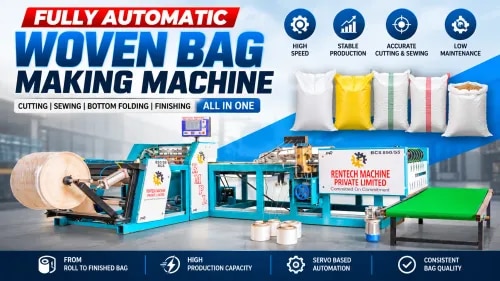
Rentech Machine Private Limited | Industrial Bag Converting Machinery 1. Product Overview The Automatic Woven Bag Making Machine from Rentech Machine Private Limited is designed to support efficient conversion of woven polypropylene (PP) fabric into finished bags for industrial packaging applications. Developed for bag manufacturers seeking consistent production quality and streamlined operations, the machine can be configured according to bag dimensions, fabric characteristics, stitching requirements, and production workflow. Depending on the selected configuration, the system can incorporate automatic fabric feeding, length measurement, cutting, bag handling, stitching, and production control functions. Integrating these operations helps manufacturers reduce repetitive manual handling, maintain uniform bag dimensions, and establish a more organized production process. The machine is suitable for packaging units producing PP woven bags for agricultural products, fertilizers, cement, grains, animal feed, chemicals, minerals, and other industrial materials, subject to the selected bag design and material compatibility. Rentech Machine Private Limited focuses on practical machinery solutions for woven bag converting applications, with machine configurations selected according to production requirements, operating conditions, and the intended finished-bag specifications. 2. A Production-Focused Approach to Woven Bag Manufacturing Modern woven bag manufacturing requires more than cutting fabric into the required length. Manufacturers must maintain dimensional consistency, control material movement, achieve reliable stitching, and minimize unnecessary handling between operations. An automatic woven bag making machine can help address these requirements through coordinated material feeding, programmed cutting, controlled bag movement, and integrated or synchronized stitching operations, where included in the selected model. Key Production Advantages Automatic Fabric Handling: The feeding arrangement supports controlled movement of woven fabric through the machine, helping maintain a stable production workflow. Consistent Bag Dimensions: Adjustable cutting length and appropriate measurement controls help produce bags according to the required specifications. Integrated Cutting Operations: The cutting mechanism separates fabric into predetermined lengths, subject to the machine's design and configuration. Reliable Stitching Integration: Compatible stitching units can be incorporated to close the required bag edge and support consistent seam formation. Operator-Friendly Controls: The control system allows operators to manage relevant machine functions and production settings according to the installed configuration. Reduced Repetitive Handling: Automation can reduce the amount of manual intervention required during repetitive converting operations. Flexible Production Configuration: Machine setup can be selected to match different bag sizes, fabric types, and finishing requirements within the model's operating limits. 3. Working Principle of the Automatic Woven Bag Making Machine The machine operates through a coordinated sequence of material feeding, measurement, cutting, and subsequent bag-finishing operations. Step 1: Fabric Loading and Feeding The woven PP fabric roll or prepared fabric web is positioned at the feeding section. The feeding arrangement guides the material into the machine while supporting controlled fabric movement. Step 2: Length Measurement and Positioning The required bag length is entered or adjusted through the available control arrangement. The feeding and measuring system positions the fabric according to the selected production setting. Step 3: Automatic Fabric Cutting The cutting mechanism separates the fabric at the programmed or mechanically adjusted interval. Proper setup helps maintain uniform bag lengths and reduce dimensional variation. Step 4: Bag Transfer and Handling The cut fabric pieces are transferred to the next processing stage. Depending on the machine configuration, this stage may involve collection, stacking, alignment, or direct transfer to a stitching unit. Step 5: Stitching and Edge Finishing Where an integrated stitching system is provided, the specified bag edge is stitched using the selected sewing arrangement. Additional finishing operations depend on the intended bag design. Step 6: Finished Bag Collection The completed bags are collected for inspection, counting, bundling, or further packaging. Operators can check dimensions, stitching quality, and overall finish before dispatch. Note: The actual process sequence depends on whether the supplied model is a cutting machine, a cutting-and-stitching machine, or a more integrated bag-converting system. 4. Industrial Applications The Automatic Woven Bag Making Machine can support the production of woven bags used across multiple industrial sectors. Agriculture and Grain Packaging: Production of woven bags for rice, wheat, pulses, seeds, and other agricultural commodities. Fertilizer Manufacturing: Conversion of suitable woven fabric into bags for fertilizer packaging, subject to the required bag design. Cement and Building Materials: Manufacturing of suitable woven packaging bags for cement, minerals, and other construction materials. Animal Feed Industry: Production of woven bags for feed, bran, and related agricultural products. Chemical and Industrial Packaging: Conversion of compatible woven fabrics into bags for industrial raw materials and granulated products. Minerals and Commodity Packaging: Manufacturing of bags for selected minerals and bulk materials, depending on the required strength and packaging specification. 5. Why Consider Rentech Machine Private Limited? Selecting a bag-making machine requires consideration of the complete production requirement rather than the machine name alone. The fabric specification, bag dimensions, stitching quality, production target, and available floor space all influence the appropriate configuration. Rentech Machine Private Limited provides machinery solutions for woven bag converting applications, with technical selection based on the customer's intended process and product requirements. Key considerations include: Machine configuration aligned with the intended bag design. Selection of suitable feeding, cutting, and finishing arrangements. Technical discussion of production requirements before finalization. Integration of compatible cutting and stitching functions where specified. Defined operating parameters and machine layout for the agreed configuration. Installation and commissioning arrangements as agreed in the quotation. Customers should request the technical specification sheet for the exact machine being offered to verify its capabilities before placing an order. 6 . Frequently Asked Questions (Q&A) Q1. What is an automatic woven bag making machine? An automatic woven bag making machine converts woven fabric, commonly polypropylene fabric, into bags through operations such as feeding, measuring, cutting, and, where configured, stitching and finishing. Q2. Which materials can be processed on this machine? The primary application is PP woven fabric. Compatibility with laminated fabric, coated fabric, or other woven materials depends on the feeding, cutting, and finishing arrangements of the selected model. Q3. Can the machine manufacture different bag sizes? Bag sizes can be adjusted within the operating limits of the machine. The available length and width ranges should be confirmed against the technical specifications before selecting a model. Q4. Does the machine include automatic stitching? Stitching is available only when included in the selected configuration. Some machines perform cutting alone, while others combine cutting and stitching or coordinate with a separate stitching unit. Q5. How is the required bag length controlled? The length is set through the available mechanical adjustment, measurement control, or programmable control system. The specific arrangement depends on the machine design. Q6. What determines the production capacity? Production capacity depends on the machine model, bag dimensions, feeding and cutting cycle, stitching speed, fabric characteristics, operator involvement, and the required quality standard. Q7. Can the machine handle different fabric GSM values? The permitted GSM range depends on the machine's feeding, cutting, and material-handling capabilities. The fabric GSM and construction should be provided during technical evaluation. Q8. Is the machine suitable for fertilizer and cement bags? It may be suitable for manufacturing compatible woven bags for these applications. The required bag construction, fabric strength, dimensions, and finishing process must be matched to the selected equipment. Conclusion The Automatic Woven Bag Making Machine by Rentech Machine Private Limited is intended for woven bag manufacturers looking to improve process consistency and organize their fabric-converting operations. With an appropriate configuration for feeding, measurement, cutting, and optional stitching, the machine can support the production of woven bags for a variety of industrial packaging applications. For the most suitable machine selection, manufacturers should evaluate the required bag dimensions, material specifications, production target, finishing operations, and plant layout. These factors help determine the appropriate machine configuration and establish realistic operating expectations. Contact Rentech Machine Private Limited to discuss your woven bag manufacturing requirements and obtain the technical details for a suitable machine configuration.
Address
67, Road No. 1, Gopalcharan Industrial Hub, Bakrol, (Bujrang)
Ahmedabad, Gujarat, India, 382430